
Is a Herniated Disc Causing Your Sciatica or Leg Pain?
H2 SUBHEADING IN THE FORM OF A QUESTION
Are you experiencing sharp lower back pain that travels down your leg? Do your symptoms come with numbness, tingling, or weakness in the leg or foot? If so, the cause may be a herniated lumbar disc pressing on a nerve.
What Is a Herniated Disc?
Between each vertebra of your spine lie spinal discs—gel-filled cushions that absorb shock and allow movement. Each disc has:
- A tough outer layer (annulus fibrosus)
- A soft inner core (nucleus pulposus)
A herniated disc occurs when the outer layer tears, allowing the inner gel to leak or “spill out”. This leaked disc material can press on nearby nerves and trigger inflammation, often leading to sciatica.
Resolve Neck, Back, and Sciatica Pain and Regain Your Function
What Causes a Herniated Disc?
A disc herniation can happen suddenly or develop over time. Common causes include:
- Bending and twisting injuries
Sudden movements—like lifting and twisting at the same time—can tear the outer disc fibers - Repetitive stress and overuse
Years of strain from sitting, heavy lifting, or repetitive motion can break down the annulus and weaken the disc - Weak spinal ligaments and instability
When spinal ligaments and stabilizing muscles are weak, excess stress is transferred to the discs, increasing the risk of herniation - Poor posture and body mechanics
Slouched sitting, forward head posture, and improper lifting load the discs unevenly, increasing disc pressure - Genetics and disc health
Some people are genetically predisposed to weaker discs with less collagen strength, making them more prone to disc injury and herniation
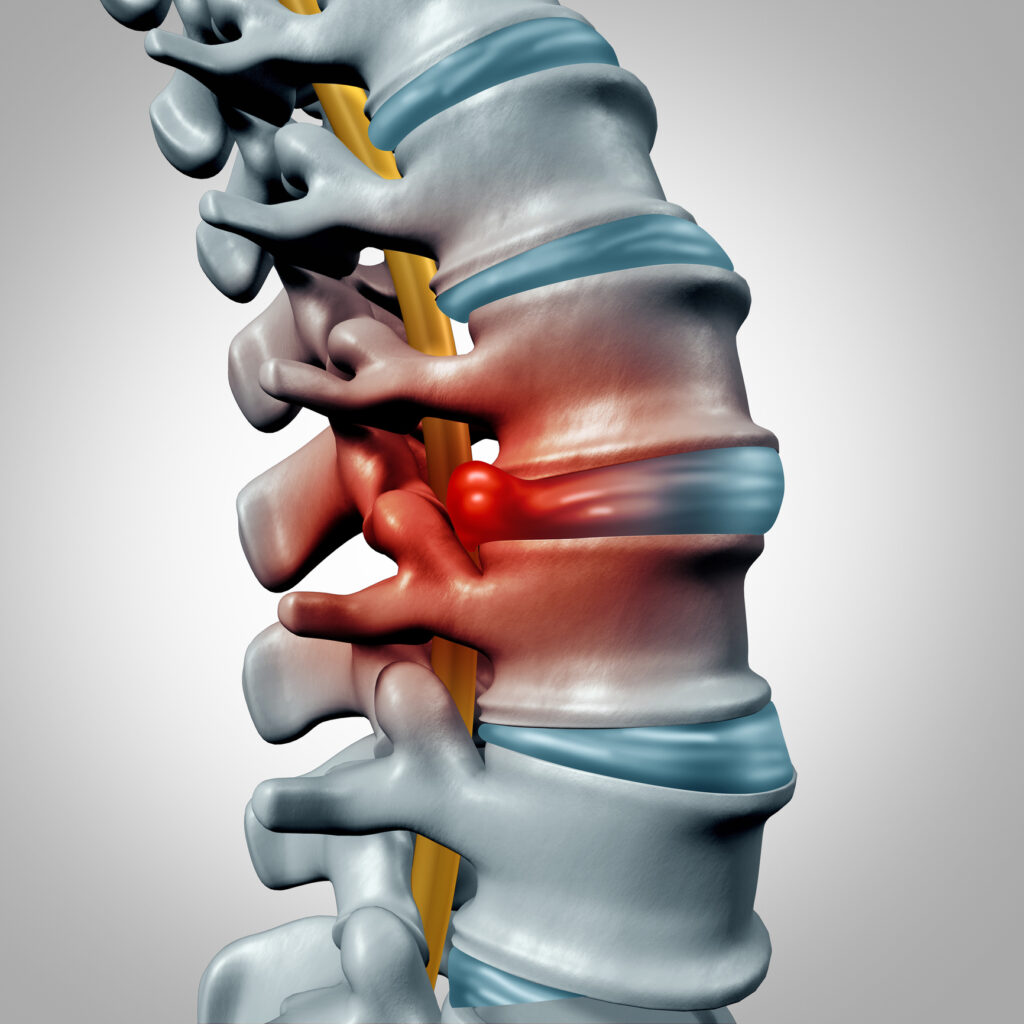
Why Herniated Discs Hurt So Much?
- Nucleus gel leaks out and irritates nerves
The disc material causes chemical inflammation and swelling in the nerve root. - Spinal nerves become compressed
This creates radiating pain, numbness and weakness and can lead to nerve damage. - Muscle guarding and spasms develop
Nearby muscles tighten to protect the injury, making movement painful.
Common Symptoms of a Herniated Lumbar Disc
- Sciatica – pain down the buttock and leg
- Leg numbness or tingling
- Muscle weakness in the leg or foot
- Pain worse with sitting, bending, coughing, or twisting
- Lower back pain with sharp flare-ups
- Limited standing and walking tolerance
Diagnosis of Herniated Discs
A proper diagnosis begins with a history and physical exam to identify nerve irritation. Spine specialists perform neurological testing to evaluate reflexes, muscle strength, sensation, and nerve tension.
Diagnostic imaging includes:
- MRI – confirms disc herniation and nerve compression
- X-rays – assess spinal alignment and disc space
- EMG testing (sometimes) – evaluates nerve damage
Diagnosis is made by matching MRI findings with symptoms and exam results.
What is the best non-surgical Treatment for Herniated Lumbar Discs
There are non-surgical treatment options that can reduce disc inflammation, improve function, and relieve nerve compression—without spinal fusion or microdiscectomy surgery.
At Integrative Rehab Medicine in Estero (serving Southwest Florida), we specialize in image-guided Regenerative Medicine treatments for back pain and sciatica from disc herniations.
Treatment options include:
Ozone Injection Therapy (O₂–O₃ Nucleolysis)
A minimally invasive procedure where medical ozone gas is injected into the herniated disc under X-ray guidance. Ozone:
- Reduces inflammation inside the disc
- Shrinks herniated disc material to relieve sciatic nerve pressure
- Improves oxygenation and healing inside the disc
→ Read more in our blog: What is the Best Treatment for a Herniated Disc Without Surgery? Ozone Disc Injections May Be The Answer
Platelet-Rich Plasma (PRP) for Discs, Nerves & Ligaments
We use advanced PRP processed in our in-house regenerative lab to treat all components of the spinal unit, not just the disc:
- PRP Epidural Injection: Reduces nerve inflammation from sciatica
- PRP for Spinal Ligaments & Joints: Improves stability to protect the disc long-term PRP supplies concentrated growth factors that repair injured soft tissue, reduce inflammation,
and restore spinal stability.
Discseel® Procedure
The Discseel® Procedure uses fibrin biologic sealant to:
- Close disc tears (annular tears)
- Stop leakage of inflammatory disc material
- Reduce chronic disc pain and re-herniation
This is ideal for patients with recurring herniated discs or failed back surgery syndrome.
Targeted Spinal Rehabilitation
We combine regenerative injections with rehabilitation to restore spinal strength, improve spinal mechanics and posture. Our therapy focuses on stability first, then mobility, ensuring long-term recovery and return to activity.
Resolve Neck, Back, and Sciatica Pain and Regain Your Function
Frequently Asked Questions
Spinal lumbar discs are strong but their weakness is when they are loaded and twisted, with a forward flexion and rotation movement, such as lifting a heavy bag and placing it into a car. Repetitive tasks that require a flexed forward position and also wear down the outer layer of the disc (annulus), cause cracks that will eventually lead to a disc herniation. Trauma such as car accidents and falls can also place enough force onto the disc to cause a herniation.
Just like all the tissues in our body, spinal disc herniations have the ability to heal on their own. The body sees the herniated disc material as an intruder and sends out immune cells such as the macrophages to “eat up” the disc material. This healing can be a slow process and can happen on its own, but it does not always occur and often the body needs a reminder to heal the disc herniation. There are many other alternatives to surgery for a herniated disc, such as ozone and PRP epidural injections that can stimulate the body to heal the disc herniation.
A large enough herniated disc can compress nerves in the spine and cause nerve damage, especially if not treated quickly. If there is severe pain and significant weakness, the disc herniation needs to be addressed ASAP in order to save the nerves from long lasting damage.
Yes, a herniated disc can compress nerves within the spine, cutting of blood supply to the nerve and causing direct damage to the nerve tissue itself. This can cause long term nerve damage if not addressed properly.
A bulging disc is when the outer layer of the disc (the annulus) becomes weak and bulges out in all direction causing the disc to flatten and expand. A herniated disc is when some of the inner core material (the nucleus) leaks out through the annulus in one direction, causing nerve compression and inflammation.
Most important way to prevent a herniated disc from coming back it to create a strong and stable spine. This can be done with specific core exercises, rebuilding of the muscles and strengthening of the ligaments (such as can be achieved with prolotherapy and PRP injections). The other important thing is to follow “spinal hygiene” – avoiding activities that can place excessive load on the disc – such as flexion and rotation positions.
If you have back pain and pain in the leg (aka sciatica) that is worse with sitting, bending and walking, along with some numbness and weakness in the leg, you may have a herniated disc. Sometimes there may be no back pain and only leg symptoms are present.
Many times disc herniations can be treated without surgery using therapy, injections of ozone or PRP and time. If you have severe weakness and pain that does not improve with conservative treatments, then surgery may be indicated.
A spinal MRI is the best way to visualize a disc herniation. X-ray will not a disc herniation. A CT scan can also be used but it is not as good as an MRI.
Resolve Neck, Back, and Sciatica Pain and Regain Your Function
Why Choose Integrative Rehab Medicine for Herniated Disc Treatment in Estero (Serving Southwest Florida)
✅ Regenerative and Non-Surgical Approach
We treat the source of back and sciatic pain from herniated discs using minimally invasive injections—no long recovery, no general anesthesia, no opioids.
✅ Precision-Guided Injections
Every injection is performed using fluoroscopy (X-ray) and ultrasound guidance — no blind injections ever.
✅ Highest Quality PRP from Our In-House Lab
We produce high-concentration PRP and custom biologics on-site for better results and strict sterility.
✅ Comfort & Safety
Procedures are performed in our Florida Board of Medicine–registered Level II Surgery Facility, with conscious sedation available for comfort.
✅ Ozone Therapy Experts
We are one of the few clinics in Southwest Florida offering ozone for herniated discs, backed by clinical research.
Many patients use our treatments to avoid microdiscectomy and spinal fusion surgery—and return to active living pain free and with restored function.


I can't thank the IRM Team enough. If you have any type of physical injury, they are the best. They embrace helping athletes!
Thanks again!

Procedure day went very smoothly. I took a very nice nap thanks to the anesthesia and woke up feeling well cared for by the nurse and supported by the entire team.
I also appreciated how clearly Dr. Sebastian explained the recovery process and set realistic expectations. The office runs efficiently, and you can truly tell they care about their patients and outcomes.
I’m so thankful I found this practice and would highly recommend Dr. Sebastian to anyone considering regenerative treatment options. 🙌🏻


While there are some studies that show PRP does work for some people, I had no benefit. Some studies do show that multiple treatments are more beneficial, but I refused to return. For me, this experience was a waste of time and money.
Lastly, I understand Dr. Klisiewicz is doing Discseel combined with PRP. This hasn't been studied in clinical trials. This is just inventing medicine and can be dangerous. That's not my opinion. That's the comment of several doctors familiar with the procedures. Even Discseel only works in 1/2 the patients. This data comes from the doctor who created the procedure. "At the 12-month follow-up, 50% of patients achieved minimal clinically important differences...".
The only reason I gave 2 stars is because of his nursing staff. They're great. If it weren't for them, this would be a zero star review.


