
Is Sacroiliac (SI) Joint Pain Causing Your Lower Back, Buttock or Hip Pain?
H2 SUBHEADING IN THE FORM OF A QUESTION
Do you have lower back pain that sits just off to one side, near the dimple of your low back or buttock? Does it hurt to stand up from a chair, roll over in bed, walk, or climb stairs? If so, your pain may be coming from the SI joint. Luckily, there are safe and effective non-surgical treatments that can provide long term relief.
What Is the SI Joint?
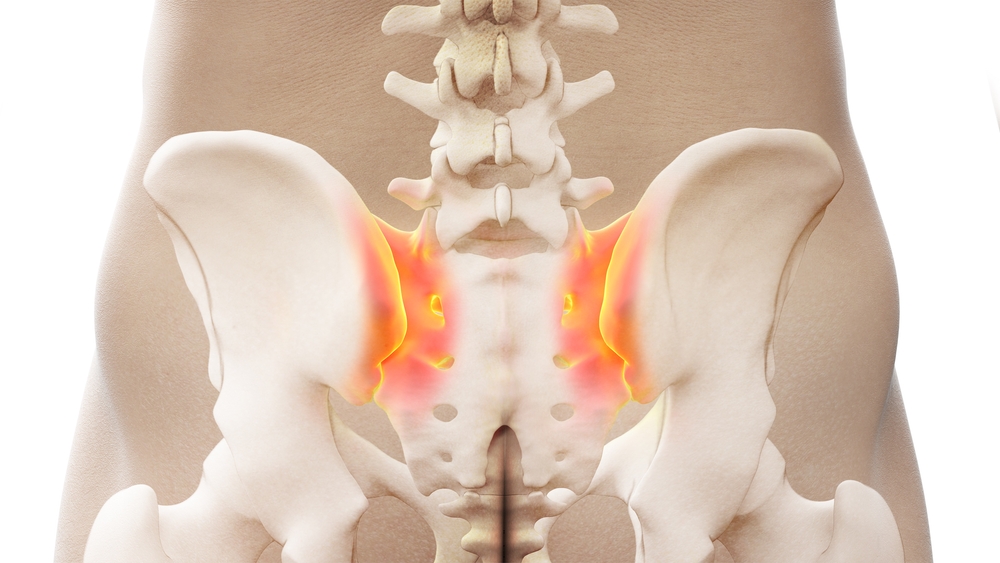
The sacroiliac (SI) joints connect the sacrum (base of the spine) to the pelvic bones (ilium) on each side. These joints are small but powerful, carrying the weight of the upper body into the hips and legs. They are stabilized by strong ligaments and muscles and work together with the
spine to support every step you take.
When the SI joint becomes inflamed, irritated, or unstable, it can cause deep lower back and buttock pain that can mimic disc, muscle or sciatica pain.
Resolve Neck, Back, and Sciatica Pain and Regain Your Function
Why Does the SI Joint Become Painful?
SI joint pain can develop due to:
- Joint instability from injured, stretched or weak ligaments
- Inflammation from overuse, arthritis, or trauma
- Pelvic asymmetry from leg length differences or posture imbalance
- Pregnancy or childbirth (ligaments naturally loosen)
- Compensation from spine problems such as degenerative discs
- Lumbar fusion surgery (extra stress shifts to the SI joints)
When the SI joint becomes irritated, surrounding muscles tighten, contributing to chronic pain and stiffness. The nearby spinal nerves can also become inflamed, causing symptoms of sciatica (leg pain and numbness).
Common Symptoms of SI Joint Pain
Patients often describe SI joint pain as:
- Pain on one side of the lower back or buttock
- Pain that may radiate into the hip, thigh, or groin
- Pain worse with standing, walking, stairs, or getting out of a car
- Sharp pain when rolling in bed or standing from sitting
- Stiffness in the lower back or pelvis
- Feeling like the back or pelvis is “misaligned”, unstable or weak
- Sciatica – pain and numbness down the leg
How Is SI Joint Pain Diagnosed?
Diagnosis begins with a detailed history and physical exam. A spine and SI joint pain specialist performs specific stress tests on the SI joint (such as Gaenslen, FABER, compression, and thigh-thrust tests) to reproduce pain from the joint.
Imaging may include:
- X-ray or MRI – to assess joint degeneration or inflammation
- Diagnostic SI joint injection – may be used to identify if the SI joint is a pain source
Treatment Options for SI Joint Pain
We treat SI pain by restoring stability, reducing inflammation, and addressing the root cause—not just masking pain.
Non-Surgical SI Joint Treatments (Offered in Estero, SW Florida):
- Ultrasound and X-ray Guided Injections – of biologics and other regenerative medicine solutions
- Prolotherapy – strengthens loose SI ligaments to stabilize the SI joint and supporting structure
- Platelet-Rich Plasma (PRP) Injections – reduces SI joint inflammation and repairs the supporting ligaments. In clinical studies, PRP has been shown to be more effective than steroids at treating SI joint pain and providing long term results. (will need the reference)
- Bone Marrow Stem Cell Therapy – promotes deeper ligament and joint healing
- Pelvic stabilization rehabilitation – strengthens glutes, core, and pelvic muscles for long-term results (works best when combined with regenerative injections)
Resolve Neck, Back, and Sciatica Pain and Regain Your Function
Frequently Asked Questions
SI joint pain is usually felt low in the back, near the pelvis or the “dimples” at the base of the spine. It can also radiate into the buttock or thigh. Pain often worsens when standing up from a seated position or after prolonged sitting.
A detailed physical exam by a spine specialist—and sometimes diagnostic injections—can help confirm whether the SI joint is the true source of pain.
SI joint pain can be short-term if caused by a mild strain or irritation, but it may become chronic if the joint or supporting ligaments are unstable or inflamed. Without proper treatment, symptoms can last for months or even years.
Non-surgical options can be very effective for SI joint pain.
Physical therapy to strengthen and stabilize the hips, pelvis, and core is a great starting point.
Regenerative treatments such as prolotherapy or PRP (platelet-rich plasma) injections can strengthen the ligaments that support the SI joint, reduce inflammation, and provide long-term pain relief—helping many patients avoid surgery.
Yes. Prolonged standing, walking, or sitting—especially on one side—can aggravate SI joint pain. Pain often flares when transitioning from sitting to standing or after remaining in one position for too long. Taking frequent breaks to stretch or move can help reduce stress on the joint.
Sacroiliitis refers to inflammation of the sacroiliac (SI) joint. It can result from trauma, repetitive stress, or autoimmune conditions such as ankylosing spondylitis.
While all sacroiliitis causes SI joint pain, not all SI joint pain is due to sacroiliitis—some may stem from ligament laxity, instability, or degeneration.
To prevent SI joint pain from recurring, focus on strengthening the muscles around your hips, pelvis, and lower back, and maintaining flexibility in the hip joints.
Treating and strengthening the supporting ligaments through prolotherapy or PRP can restore joint stability and help prevent future flare-ups.
Yes. After a lumbar spine fusion—especially at L4-L5 or L5-S1—the SI joints often take on extra stress to compensate for lost motion in the fused segments. Over time, this can lead to SI joint degeneration, inflammation, and pain.
An MRI is not always needed to diagnose SI joint pain. Diagnosis is typically based on a detailed physical exam and specific movement tests that reproduce symptoms.
In some cases, X-rays or diagnostic SI joint injections may be used to confirm the diagnosis.
Yes. A leg length difference or hip imbalance can increase stress on one or both SI joints, leading to inflammation and degeneration.
When the hips or pelvis move unevenly, the SI joint must absorb more load, which can cause chronic pain. Correcting alignment and strengthening supporting muscles can help restore balance and reduce symptoms.
Resolve Neck, Back, and Sciatica Pain and Regain Your Function
Why Choose Integrative Rehab Medicine for your SI Joint Treatment?
At Integrative Rehab Medicine in Estero, FL (serving Southwest Florida), we do more than mask pain—we fix the root cause of SI joint pain.
✅ Non-Surgical, Long-Term Relief from SI Joint Pain
Steroid injections only mask pain temporarily. Our regenerative treatments repair and stabilize the SI joint by targeting inflammation and ligament damage—without surgery.
We treat the entire SI joint complex, not just the joint space, including:
- Joint capsule
- Supporting ligaments
- Pelvic stabilizers
This restores true joint stability and delivers lasting pain relief.
✅ Whole-Body Evaluation for Better Results
SI joint pain rarely exists alone. We identify why your SI joint became painful in the first place by treating related regions that overload it:
- Hip joint (arthritis, mobility loss)
- Lumbar spine (degenerative discs, facet pain)
- Pelvis & core (weak stability)
- Knee & ankle alignment (gait problems)
Correcting these imbalances prevents flare-ups and improves long-term outcomes.
✅ Precision-Guided Injections + Highest Quality Regenerative Medicine
All treatments are done with ultrasound and fluoroscopy (X-ray) guidance for precise and safe injection placement—no blind injections ever.
We also process all PRP and regenerative biologics in our on-site sterile lab, allowing us to:
- Create high-concentration PRP
- Customize treatments for discs, joints, and ligaments
- Maintain strict quality and sterility
- Deliver consistent, superior results
Better accuracy + better biologics = better outcomes.
For the best non-surgical treatments of Sacroiliac (SI) Joint Pain offered in Estero FL (southwest FL), contact our clinic and schedule a consultation.


I can't thank the IRM Team enough. If you have any type of physical injury, they are the best. They embrace helping athletes!
Thanks again!

Procedure day went very smoothly. I took a very nice nap thanks to the anesthesia and woke up feeling well cared for by the nurse and supported by the entire team.
I also appreciated how clearly Dr. Sebastian explained the recovery process and set realistic expectations. The office runs efficiently, and you can truly tell they care about their patients and outcomes.
I’m so thankful I found this practice and would highly recommend Dr. Sebastian to anyone considering regenerative treatment options. 🙌🏻


While there are some studies that show PRP does work for some people, I had no benefit. Some studies do show that multiple treatments are more beneficial, but I refused to return. For me, this experience was a waste of time and money.
Lastly, I understand Dr. Klisiewicz is doing Discseel combined with PRP. This hasn't been studied in clinical trials. This is just inventing medicine and can be dangerous. That's not my opinion. That's the comment of several doctors familiar with the procedures. Even Discseel only works in 1/2 the patients. This data comes from the doctor who created the procedure. "At the 12-month follow-up, 50% of patients achieved minimal clinically important differences...".
The only reason I gave 2 stars is because of his nursing staff. They're great. If it weren't for them, this would be a zero star review.


With more positive improvement coming long term my advice why wait call or visit them. Integrative Rehab Medicine is the very best non-surgical treatment of the spinal discs.
I excited about my future living without pain. Make this appointment your health will Thank you later.
Chris Drikakis
A fellow golfer and Vietnam veteran
We’re thrilled to hear that just one month after your non-surgical spinal disc procedure, your consistent pain has resolved and that you’re continuing to make progress. At Integrative Rehab Medicine, our mission is to help patients avoid unnecessary spine surgery by offering advanced, evidence-based treatments for chronic back and neck pain, including non-surgical disc repair options such as Discseel® and PRP.
Your story highlights exactly why we focus on treating the underlying cause of disc-related pain—not just masking symptoms—and why so many active patients, including golfers and veterans, seek out non-operative spine care with us. We’re excited about your continued improvement and long-term recovery.
https://irehabmed.com/va
Thank you again for your kind words.
