
Is Your Back and Leg Pain Really Sciatica?
H2 SUBHEADING IN THE FORM OF A QUESTION
Do you feel sharp, burning, or shooting pain that runs from your lower back down your leg?
Maybe there’s numbness, tingling, or weakness that makes standing or walking difficult.
This kind of pain is commonly called sciatica— understanding the source of the pain is essential for the right diagnosis and an effective treatment.
What Is Sciatica?
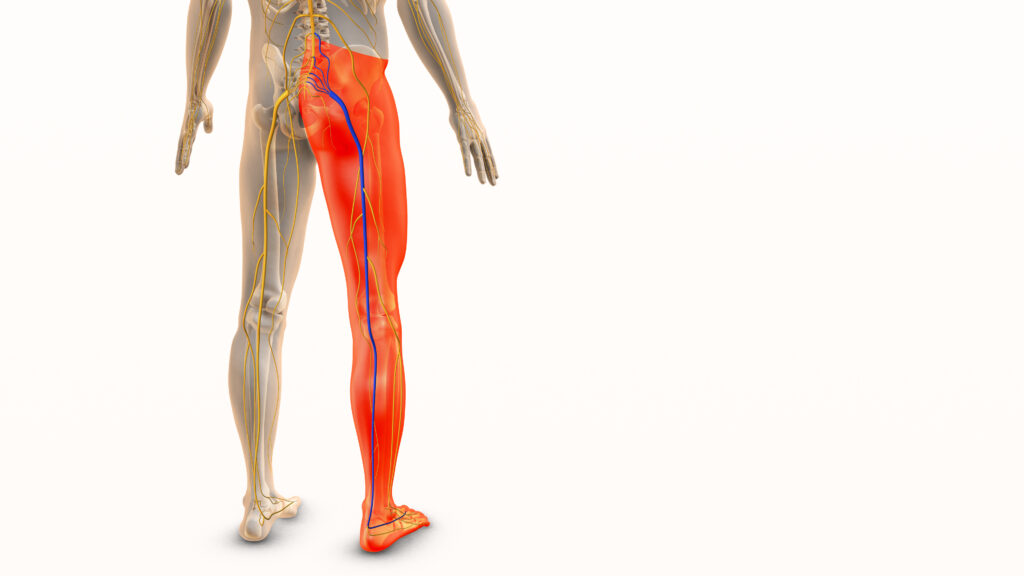
Sciatica refers to pain that travels down the leg along the path of the sciatic nerve—the largest nerve in the body. The sciatic nerve originates from several spinal nerve roots in the lower back (L4, L5, S1, and S2) that merge together in the pelvis to form the sciatic nerve. It runs down the back of the thigh and divides into the tibial and fibular nerves in the lower leg.
The most common cause of sciatica is a herniated or bulging lumbar disc, which can compress one of the spinal nerve roots (typically L4, L5, or S1) that contribute to the sciatic nerve. A degenerated or “leaky” disc can also release inflammatory proteins that irritate the spinal nerves, even without major mechanical compression. Both of these mechanisms can inflame the nerve and trigger radiating leg pain, numbness, or weakness.
Other conditions can contribute to or mimic sciatica, including:
- Foraminal stenosis – narrowing of the bony tunnel where the spinal nerve exits, which can compress the nerve and reproduce sciatic-type pain.
- Sacroiliac (SI) joint dysfunction or inflammation – irritation of the L5 and S1 nerve roots can occur as they run in front of the SI joints, this can produce referred pain that radiates down the leg.
- Hamstring tendinosis or ischial bursitis – inflammation at the “sit bone” can irritate the nearby sciatic nerve, causing pain that feels identical to sciatica.
- Piriformis syndrome – compression of the sciatic nerve as it passes beneath the piriformis muscle deep in the buttock.
Accurate diagnosis is key because treatment depends on identifying the true pain generator.
Resolve Neck, Back, and Sciatica Pain and Regain Your Function
Why Does Sciatica Hurt So Much?
When a spinal nerve root becomes compressed or inflamed, these nerves and the entire sciatic nerve become hypersensitive, producing pain, tingling, or burning sensations that can extend from the lower back to the calf or foot. Inflammatory chemicals released from a herniated or degenerated disc can further irritate these nerves, making it painful even without significant mechanical compression.
Common Symptoms of Sciatica
- Pain radiating from the lower back or buttock down one leg
- Numbness, tingling, or burning sensation along the leg or foot
- Muscle weakness in the leg or difficulty standing on toes or heels
- Pain that worsens with sitting, coughing, or bending forward
- Sometimes there is relief when lying down, standing or walking
Diagnosing Sciatica
A precise diagnosis begins with a thorough patient history, detailed physical examination, and when necessary, advanced imaging. Our spine specialists carefully evaluate spinal and pelvic function, muscle strength, reflexes, and nerve tension to pinpoint the exact source of irritation or compression causing your symptoms.
Imaging Studies
MRI or CT scans can help identify herniated discs, stenosis, or inflammation around the nerve roots. However, imaging alone doesn’t always reveal the full picture, since many people have disc herniations without symptoms.
Diagnostic Injections
Sometimes, a precisely placed injection can help confirm whether the pain is coming from the disc, nerve root, or SI joint.
Treatment Options for Sciatica
Why Conventional Treatments Often Fall Short
Traditional pain management for sciatica typically involves steroid epidural injections. While these can temporarily reduce inflammation, the effects are short-lived, and steroids carry potential side effects such as elevated blood sugar, muscle loss, immune suppression, and bone thinning (osteoporosis). Moreover, steroid injections do not repair the underlying problem—whether that’s a herniated disc, ligament laxity, or nerve irritation.
A Better Option: Regenerative Medicine – Treating the Root Cause
At Integrative Rehab Medicine in Estero, Florida, we use advanced regenerative treatments to heal and stabilize the spine, calm inflamed nerves, and repair damaged tissues—naturally.
Each procedure is image-guided (fluoroscopy or ultrasound) to ensure precision and safety.
PRP Epidural Injections
Using your body’s own platelet-rich plasma, we can deliver growth factors directly around the irritated nerve root. PRP resolves inflammation, enhances healing of the surrounding tissues, and promotes long-term improvement—without the side effects of steroids.
Ozone Therapy for Herniated Discs
For patients with disc herniations, ozone injections can shrink the disc material, reduce inflammation, and improve oxygenation to surrounding tissues. This treatment has been shown to relieve pressure on the nerve root and promote natural healing of the disc.
Prolotherapy and PRP
If the pain source is SI joint dysfunction, or spinal ligament laxity, prolotherapy or PRP can strengthen the supporting ligaments, restore stability, and reduce referred leg pain that mimics sciatica.
Sciatic Nerve Hydrodissection
For cases of nerve entrapment or irritation, ultrasound-guided hydrodissection gently releases the sciatic nerve from surrounding tissues using a regenerative solution. This can immediately improve mobility and reduce sciatica pain.
Discseel® Procedure
For patients with annular tears or disc leaks, the Discseel® procedure offers a non-surgical option to seal and repair damaged discs using a fibrin sealant. This helps restore disc integrity, prevent further leakage of inflammatory proteins, and relieve nerve irritation at its source—often improving both back pain and sciatica symptoms.
Spinal Physical Therapy
Regenerative therapies are most effective when combined with a customized rehabilitation program that focuses on improving core stability, spinal mobility, and muscle coordination.
We also emphasize lifestyle strategies that reduce inflammation and support long-term recovery.
Resolve Neck, Back, and Sciatica Pain and Regain Your Function
Frequently Asked Questions
Sciatica refers to pain that travels down the leg from irritation or compression of the sciatic nerve in the back or buttock.
If you have pain, tingling, numbness, or burning that runs from your lower back or buttock into your leg—especially when sitting—you may be experiencing sciatica.
Sciatica can be caused by a variety of conditions that irritate or pinch the sciatic nerve, including:
- A herniated or bulging disc pressing on a nerve root in the spine
- Inflammation or entrapment of the nerve in the buttock or pelvis
- Tight muscles, such as the piriformis, compressing the sciatic nerve
- Degenerative or arthritic changes in the lower spine
- Sacroiliac (SI) joint dysfunction
In many cases, sciatica can be resolved without surgery by addressing the underlying cause. Non-surgical and regenerative treatments that can provide long-term relief include:
- PRP (platelet-rich plasma) injections into the spine
- Nerve hydrodissection procedures to release and heal the nerve
- Physical therapy and corrective exercise
These treatments help the body heal inflammation and reduce pressure on the sciatic nerve.
The duration of sciatica depends on the cause and severity of nerve irritation.
For some people, mild sciatica improves within a few weeks. For others, symptoms may last for months or even years if the underlying problem isn’t addressed.
Regenerative treatments such as prolotherapy, PRP injections, nerve hydrodissection, or PRP epidural injections can help the nerve heal and speed recovery.
You should see a doctor if your sciatica is not improving with rest or over-the-counter treatments, or if you develop:
- Severe or worsening pain
- Weakness or numbness in your leg or foot
- Difficulty walking or standing
- Loss of bowel or bladder control (a medical emergency)
Prompt evaluation can prevent long-term nerve damage and help you recover faster.
Most cases of sciatica improve without surgery. Even when caused by a herniated disc or nerve compression, there are effective regenerative treatments—such as PRP epidural injections, ozone disc therapy, or the Discseel® procedure—that can help heal the disc, reduce nerve irritation, and relieve sciatica without surgery.
Yes. Sitting for long periods increases pressure on the discs and nerves in the lower spine and buttocks, which can aggravate sciatica symptoms.
Taking breaks to stand, stretch, and walk throughout the day can reduce irritation of the sciatic nerve.
Sciatica is a symptom, not a diagnosis. It refers to pain radiating along the sciatic nerve.
A herniated disc is one possible cause, but sciatica can also result from inflammation around the nerve, SI joint dysfunction, or compression in the buttock or pelvis.
The best way to prevent sciatica is to keep your spine strong, stable, and flexible.
Regular core strengthening, maintaining good posture, and avoiding positions that strain your lower back are key.
Regenerative treatments such as prolotherapy, PRP, ozone, or Discseel® can also help restore spinal health and reduce the risk of recurrence.
If your symptoms persist or are severe, an MRI of the lumbar spine is the best way to identify nerve compression or disc injury.
An MRI helps determine whether the sciatica is coming from a herniated disc, spinal arthritis, or another source, guiding the most effective treatment plan.
Resolve Neck, Back, and Sciatica Pain and Regain Your Function
Why Choose Integrative Rehab Medicine
At Integrative Rehab Medicine in Estero, Florida, our spine specialists are leaders in non-surgical regenerative treatments for sciatica and lumbar radiculopathy. Patients choose us because we offer:
- Highly trained, nationally recognized physicians specializing in regenerative spine care
- An in-house biologics laboratory for superior quality PRP and stem cell preparations
- Image-guided precision using fluoroscopy and ultrasound for every procedure
- Integrated rehabilitation and nutrition support for whole-body recovery
If you’re struggling with sciatica or leg pain that hasn’t improved with traditional care, discover a regenerative approach designed to heal—not just mask—the problem.
Contact Integrative Rehab Medicine today to schedule your consultation and start your recovery.


I can't thank the IRM Team enough. If you have any type of physical injury, they are the best. They embrace helping athletes!
Thanks again!

Procedure day went very smoothly. I took a very nice nap thanks to the anesthesia and woke up feeling well cared for by the nurse and supported by the entire team.
I also appreciated how clearly Dr. Sebastian explained the recovery process and set realistic expectations. The office runs efficiently, and you can truly tell they care about their patients and outcomes.
I’m so thankful I found this practice and would highly recommend Dr. Sebastian to anyone considering regenerative treatment options. 🙌🏻


While there are some studies that show PRP does work for some people, I had no benefit. Some studies do show that multiple treatments are more beneficial, but I refused to return. For me, this experience was a waste of time and money.
Lastly, I understand Dr. Klisiewicz is doing Discseel combined with PRP. This hasn't been studied in clinical trials. This is just inventing medicine and can be dangerous. That's not my opinion. That's the comment of several doctors familiar with the procedures. Even Discseel only works in 1/2 the patients. This data comes from the doctor who created the procedure. "At the 12-month follow-up, 50% of patients achieved minimal clinically important differences...".
The only reason I gave 2 stars is because of his nursing staff. They're great. If it weren't for them, this would be a zero star review.


With more positive improvement coming long term my advice why wait call or visit them. Integrative Rehab Medicine is the very best non-surgical treatment of the spinal discs.
I excited about my future living without pain. Make this appointment your health will Thank you later.
Chris Drikakis
A fellow golfer and Vietnam veteran
We’re thrilled to hear that just one month after your non-surgical spinal disc procedure, your consistent pain has resolved and that you’re continuing to make progress. At Integrative Rehab Medicine, our mission is to help patients avoid unnecessary spine surgery by offering advanced, evidence-based treatments for chronic back and neck pain, including non-surgical disc repair options such as Discseel® and PRP.
Your story highlights exactly why we focus on treating the underlying cause of disc-related pain—not just masking symptoms—and why so many active patients, including golfers and veterans, seek out non-operative spine care with us. We’re excited about your continued improvement and long-term recovery.
https://irehabmed.com/va
Thank you again for your kind words.
